
Lumetec
Updated: Mar 23
Protecting What Connects Us: Distributed Acoustic Sensing (DAS) to Defend Undersea Infrastructure
Mission

Lumetec has leveraged emerging AI and compute technologies to significantly improve the performance of Distributed Acoustic Sensing for the protection of undersea infrastructure, with an initial focus on undersea communications and power cables.
Problem
More than 95% of the world’s data and a majority of our renewable energy travels by undersea cable. Undersea communications cable costs $25,000-40,000 per kilometer to lay and an average repair is $3 million (without the costs incurred by the disruption, which can reach $1.5 million / hour of outage).
Undersea power cables cost $2-4.5 million per kilometer to lay and repairs range from $2-100 million. 98% of accidental and intentional damage to these assets occurs within 25 miles of the shore landing station and in water depths of 200 meters or less.
Solution
Lumetec has developed a proprietary, patented solution that leverages advances in AI and computing power to turn communications and power cables into sensors that help to protect themselves by alerting operators to bottom-of-the-sea activity in time to intervene.

Sound and seismic energy that reach the cable impose measurable changes in the light moving through the cable (even power cables now have fiber optics in them). Lumetec can identify the nature of the change and the location in the cable where it occurred, to provide real time awareness of surface activity and bottom contact close to the cable, allowing intervention before damage occurs or attribution that can offset repair costs if damage does occur.
The underlying technology (Distributed Acoustic Sensing) has been available for around 30 years. The oil and gas industry invested heavily in improving the hardware involved in the process between ~2000 and 2020.
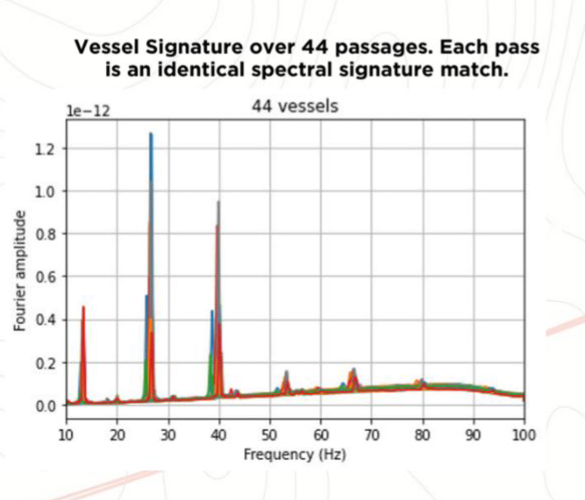
Lumetec uses those improvements and adds AI signal processing to produce previously impossible levels of cable awareness that can be leveraged by operators to protect their assets and by insurers to better quantify and price risk.
Market size
Lumetec has two business models:
cable protection; and
data as a service.
Cable Protection:
TAM: Total asset value (data and power cables) is estimated between $25-30 billion. Willingness to pay for protection, in the aggregate, is ~10% of asset value over its life (varies based on cable location and assessed risk, etc.), resulting in a TAM of ~$2.4 billion.
SAM: Cable operators are divided roughly 35% (Asia), 30% (N America), 25% (Europe), 10% (Other). We are initially focused on N America and Europe, collectively providing ~50% of the market, resulting in a SAM of ~$1 billion.
SOM: We believe we can capture 10-15% of that market through partnerships with cable service providers like UltraMap Global and a focus on cables in high risk areas where premium rates are appropriate, resulting in a SOM of ~$120M over 3-5 years.
Data as a Service:
TAM: The global Maritime Domain Awareness and Oceanic Science data markets are estimated at $20-28 billion, resulting in a conservative TAM of ~$21 billion.
SAM: Approximately ⅓ of that market pays for multi-source, high resolution data to provide information on dark shipping, illegal fishing, smuggling, mammal migrations and other specialized needs, resulting in a SAM of ~$6.9 billion.
SOM: We believe we can capture 25-33% of that market because we provide critical data that cannot be gathered from prevailing sources such as AIS and radar, resulting in a SOM of ~2.4 billion.
Target Customers

We are initially selling the cable protection service to large cable operators and the data as a service to cable insurers. The data as a service offering will expand quickly, as our access to cable data increases, to include partners that provide maritime domain awareness products.
Go-to-Market Strategy
Our go-to-market strategy is an initial focus on commercial communications and power cable protection with follow-on expansion into the commercial and government data-as-a-service market. We are rapidly acquiring customers through strategic partnerships with cable monitoring services, cable operators, hardware providers, maritime infrastructure insurance firms and maritime domain awareness services. We have at least one partnership in each category confirmed.
Exit Strategy
Our exit strategy is an acquisition by a large strategic partner. Several potential acquirors are among our current customers.
Traction
Due to our work with critical infrastructure and large clients, our sales cycle tends to be long (on the order of 6-9 months) and include proof of concept pilot periods. We currently have paying customers in North America and the EU, and numerous pilot projects in progress in the EU, MENA and Asia. We are early revenue stage and preparing to raise our Series A investment round to begin scaling.
Business Model
We have two primary revenue streams: SaaS subscriptions which support cable and infrastructure protection, and DaaS which supports maritime domain awareness, ocean science and other applications.
Financials
We are early revenue stage and expect to reach break even by Q2 2027.
Team
Our founders, Zack Spica and Jorge Castellanos are both PhD scientists and the team includes pedigrees from Google, Stanford, Cal Tech, University of Michigan, the telecoms industry and the U.S. military.
Funding
We have raised ~$3 million to date, with our largest investor being the University of Michigan’s MINTS venture fund. We will raise a Series A round in Q3-4 2026 in order to build out the engineering and sales teams and scale growth internationally.
Contact Information
Dr. Zack Spica, CEO / Founder
Dr. Jorge Castellanos, CTO / Founder
CAPT Scott Tait, USN(Ret), COO
This article was written by a third-party business or organisation.
marinn.ai has not conducted due diligence on the company or organisation.
This content is for informational purposes only and does not constitute investment advice or a solicitation.


